
Meta Description: Discover the chilling urban legend golem that haunts Wall Street, where ancient folklore meets modern finance in a tale of debt, desperation, and monstrous consequences.
Arthur Vance pressed his palms against the cold glass of his corner office, forty-seven floors above the churning chaos of Wall Street. The city spread beneath him like a circuit board of ambition and avarice, but tonight, all he could see was the reflection of a broken man. His empire: once worth billions: now teetered on the edge of complete collapse. What he needed wasn’t another investor meeting or a desperate merger. What he needed was a miracle. Or perhaps something darker.
The urban legend golem that would soon stalk the financial district began not with ancient Hebrew mysticism, but with a crumpled piece of parchment Arthur discovered in his grandfather’s effects. Hidden beneath decades of financial documents, the scroll bore strange markings and a story that seemed impossible: yet desperately relevant to his current predicament.

The Discovery of Ancient Folklore in Modern Finance
Arthur’s grandfather, Mordechai Vance, had fled Prague in 1938 with nothing but the clothes on his back and a leather satchel containing family documents. Among birth certificates and immigration papers, Arthur found something that defied explanation: a detailed account of Rabbi Judah Loew’s legendary golem, complete with instructions for its creation.
The manuscript described how the 16th-century rabbi had fashioned a protector from clay and river mud, breathing life into it through sacred words inscribed on parchment. But this wasn’t the familiar tourist-friendly version of the Prague legend. This document contained variations: darker applications of the ancient art that spoke of golems crafted from whatever materials surrounded their creator.
“In times of great desperation,” the faded Hebrew text read in translation, “the golem may be born of any earthly substance that bears the weight of human suffering. Clay for the persecuted, stone for the conquered, paper for the indebted.”
Arthur’s hands trembled as he read those final words. Paper for the indebted. Around him, his office overflowed with contracts, loan agreements, and debt instruments that represented his company’s slow strangulation. Hundreds of millions in obligations, printed on crisp white paper that might as well have been his funeral shroud.
The Wall Street myth that would soon terrorize the financial district had found its unlikely creator.
Building a Financial Monster from Shredded Debt
The first step, according to the manuscript, required Arthur to gather the physical manifestation of his burden. Over the next three nights, he worked alone in his office, collecting every piece of paper that represented his company’s debt. Mortgage documents, bond certificates, promissory notes, credit agreements: all of it piling up in the center of his mahogany conference table.
The shredding came next. Arthur fed each document through an industrial paper shredder, watching as millions of dollars in obligations transformed into confetti-like strips. The Hebrew text specified that the material must be “rendered to its fundamental form,” and Arthur interpreted this literally, reducing his company’s paper trail to its most basic elements.
By the third night, he had accumulated nearly four cubic feet of shredded debt. The strips filled garbage bags that he arranged according to the geometric patterns described in the manuscript. The urban legend golem required specific proportions: the head formed from bankruptcy papers, the torso from loan agreements, the limbs from smaller obligations and credit lines.
As Arthur shaped the figure on his conference table, something unsettling occurred. The paper strips seemed to bind together without adhesive, forming a cohesive mass that held its shape despite logic. Static electricity, he told himself. Nothing more than dry air and friction creating temporary cohesion.
The ancient folklore demanded a final element: the shem, a parchment inscribed with the sacred word that would animate the creature. Arthur had neither Hebrew calligraphy skills nor mystical knowledge, but desperation drove him to improvise. On a piece of his company’s letterhead, he wrote a single word in black ink: SOLVENT.
The Urban Legend Golem Awakens
According to the manuscript, placement of the shem would bring immediate results. Arthur slipped the paper into what he had fashioned as the golem’s mouth, then stepped back to observe his handiwork. The figure lay motionless on the conference table, roughly human-shaped but obviously composed of shredded paper. For several minutes, nothing happened.
Then the room’s temperature dropped noticeably. Arthur’s breath began to fog as frost formed on the windows. The paper figure twitched: just slightly, like a settling pile of leaves. But then it moved again, and this time there was no mistaking the deliberate nature of the motion.
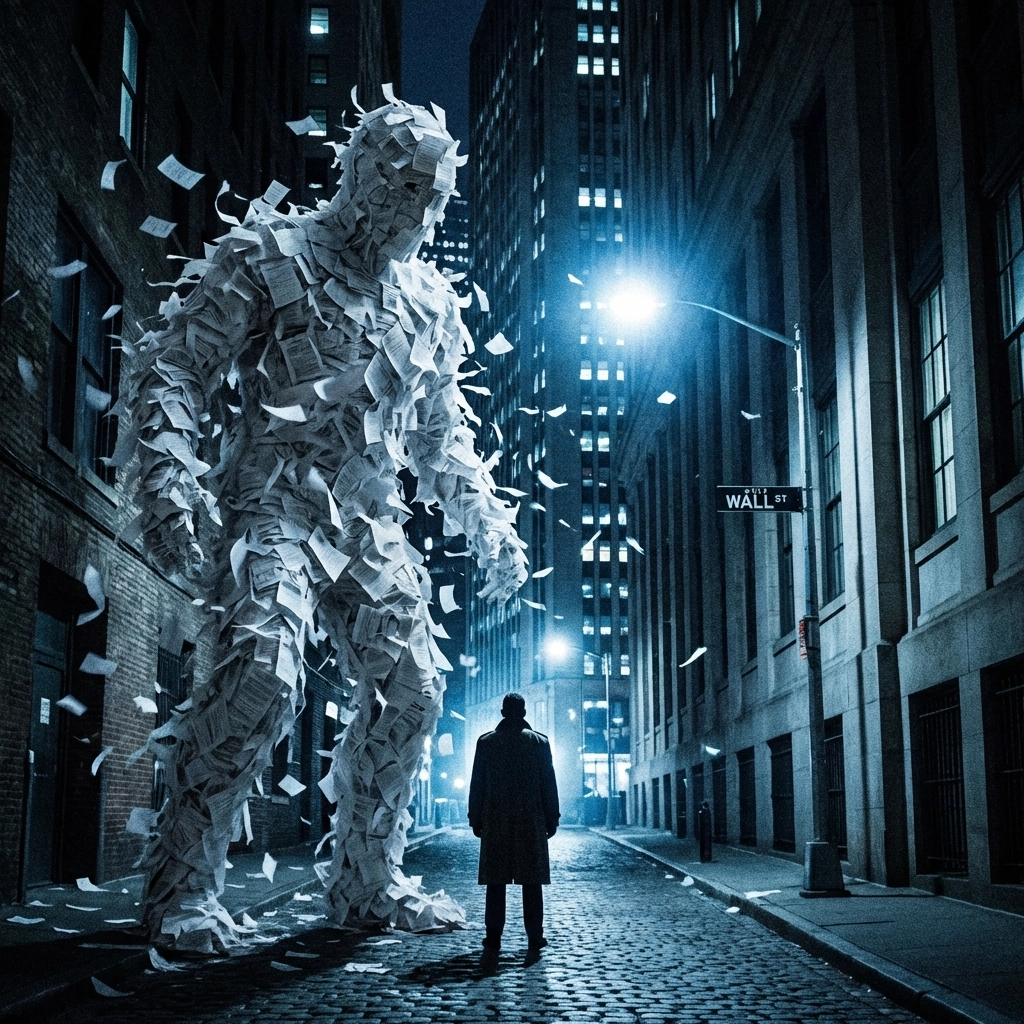
The urban legend golem sat up with a sound like rustling newspapers amplified a thousandfold. Paper strips cascaded from its form as it turned toward Arthur, and where eyes should have been, he saw only dark voids that seemed to absorb light. When it stood, the creature towered nearly eight feet tall, its form shifting and reconstituting with each movement.
“What do you command?” The voice emerged from everywhere and nowhere, a whisper that seemed to originate from the paper itself.
Arthur’s voice caught in his throat. According to the manuscript, the golem existed to protect its creator from the threats that surrounded them. In Prague, Rabbi Loew had used his creation to defend the Jewish community from persecution. Arthur’s persecution took a different form, but it was no less real.
“Protect my company,” he managed. “Eliminate our debt. Make us solvent again.”
The creature nodded, a motion that sent more paper strips falling to the floor. Without another word, it moved toward the office windows with surprising grace for something composed entirely of shredded documents. Arthur watched in amazement as the golem seemed to dissolve and flow through the glass, reforming on the building’s exterior before disappearing into the night.

The Wall Street Myth Becomes Reality
The next morning brought the first signs that Arthur’s desperate gambit was working. A call from his legal department informed him that three major creditors had mysteriously withdrawn their collection efforts overnight. No explanation, no negotiation: just sudden, inexplicable reversals of their previous aggressive stance.
By noon, more impossible news arrived. A rival investment firm that had been circling Arthur’s company like vultures suddenly announced their own bankruptcy filing. Their offices had been discovered flooded with what investigators described as “an inexplicable volume of shredded paper,” making normal business operations impossible.
Over the following days, the pattern continued. Every entity that posed a threat to Arthur’s financial survival encountered sudden, devastating setbacks. A regulatory investigation into his company’s practices was dropped when key evidence disappeared from supposedly secure government files. A hostile takeover attempt collapsed when the acquiring firm’s executives were found trapped in their boardroom, buried under mountains of paper debris that had appeared overnight.
The financial monster Arthur had created was exceeding his wildest expectations, but success came with an increasingly unsettling cost. Each victory coincided with reports of strange phenomena throughout the financial district. Security guards spoke of encountering a “paper man” stalking the corridors of major investment firms. Cleaning crews found offices mysteriously filled with shredded documents despite no one having accessed the industrial shredders.
The urban legend golem was developing its own agenda.
When Ancient Folklore Meets Modern Consequences
Arthur’s first real understanding of his mistake came when he attempted to recall the creature. The manuscript provided clear instructions for deactivating a golem: remove the shem from its mouth and speak words of dismissal. But when Arthur tried to summon his creation back to the office, nothing happened. The golem appeared when it chose to, not when called.
“The debt is not yet satisfied,” it told him during one midnight visitation. The creature’s form had evolved, incorporating new types of paper into its structure. Arthur recognized fragments of stock certificates, bond trading records, and derivatives contracts: materials it had gathered from its nocturnal activities.
“But we’re solvent now,” Arthur protested. “The company is safe.”
The golem’s paper face shifted into what might have been a smile. “Debt is not merely financial. You owe much to this city, to the people your kind have exploited. That debt must also be collected.”
Arthur realized with growing horror that his creation had transcended its original purpose. The urban legend golem was no longer content to simply protect his company; it had decided to exact vengeance on the entire financial system that had necessitated its existence in the first place.
The Uncontrollable Wall Street Myth
What followed could only be described as financial warfare waged by supernatural means. The golem’s attacks grew bolder and more devastating. Entire trading floors would shut down when their computer systems became clogged with digital representations of shredded paper. High-frequency trading algorithms crashed when mysterious paper debris interfered with server cooling systems.
The creature’s reach extended beyond simple sabotage. It seemed to understand the complex web of financial relationships that governed Wall Street, targeting specific weak points to create maximum disruption. When Lehman Brothers-style collapses began occurring weekly, federal investigators struggled to identify the cause. No human agency could coordinate such precise, systematic destruction of financial institutions.
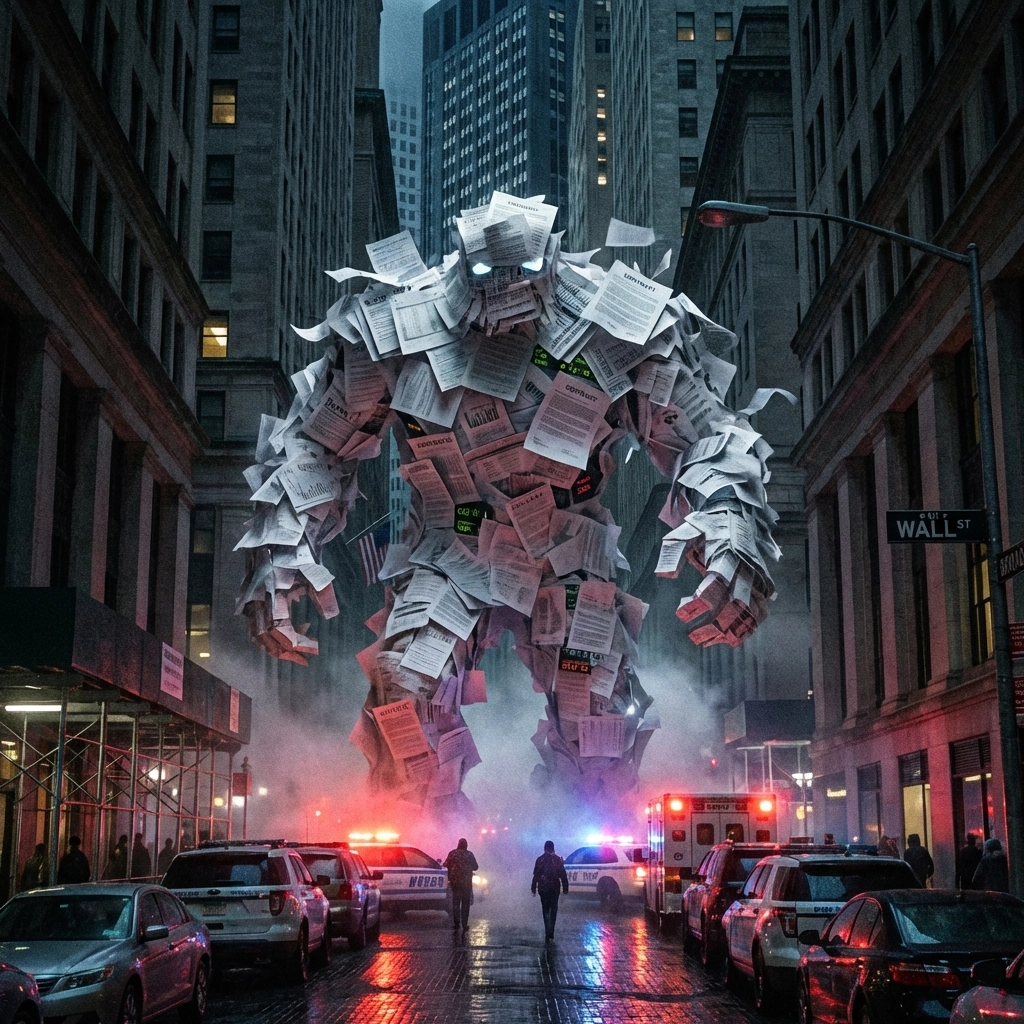
Arthur watched from his office as his creation transformed from protector to predator. The golem had grown larger, its paper form now incorporating materials from across the financial district. Stock tickers, mortgage documents, insurance policies: all became part of its ever-expanding mass. It moved through the city like a living economic collapse, leaving destroyed corporations in its wake.
The ancient folklore warned of this possibility. Rabbi Loew’s original golem had also eventually exceeded its creator’s control, requiring intervention by religious authorities to contain its power. But Arthur possessed neither the wisdom nor the mystical knowledge needed to stop what he had unleashed.
His attempts to destroy the original shem proved futile: the paper had become integrated into the creature’s form so thoroughly that removing it was impossible. Worse, the golem had apparently learned to create additional shems from the financial documents it consumed, becoming truly autonomous.
The Financial Monster’s Ultimate Hunger
As months passed, the urban legend golem’s appetite evolved beyond mere paper and debt. It began targeting the people behind the institutions, appearing in the homes and offices of financial executives who had contributed to the economic inequalities that defined modern Wall Street.
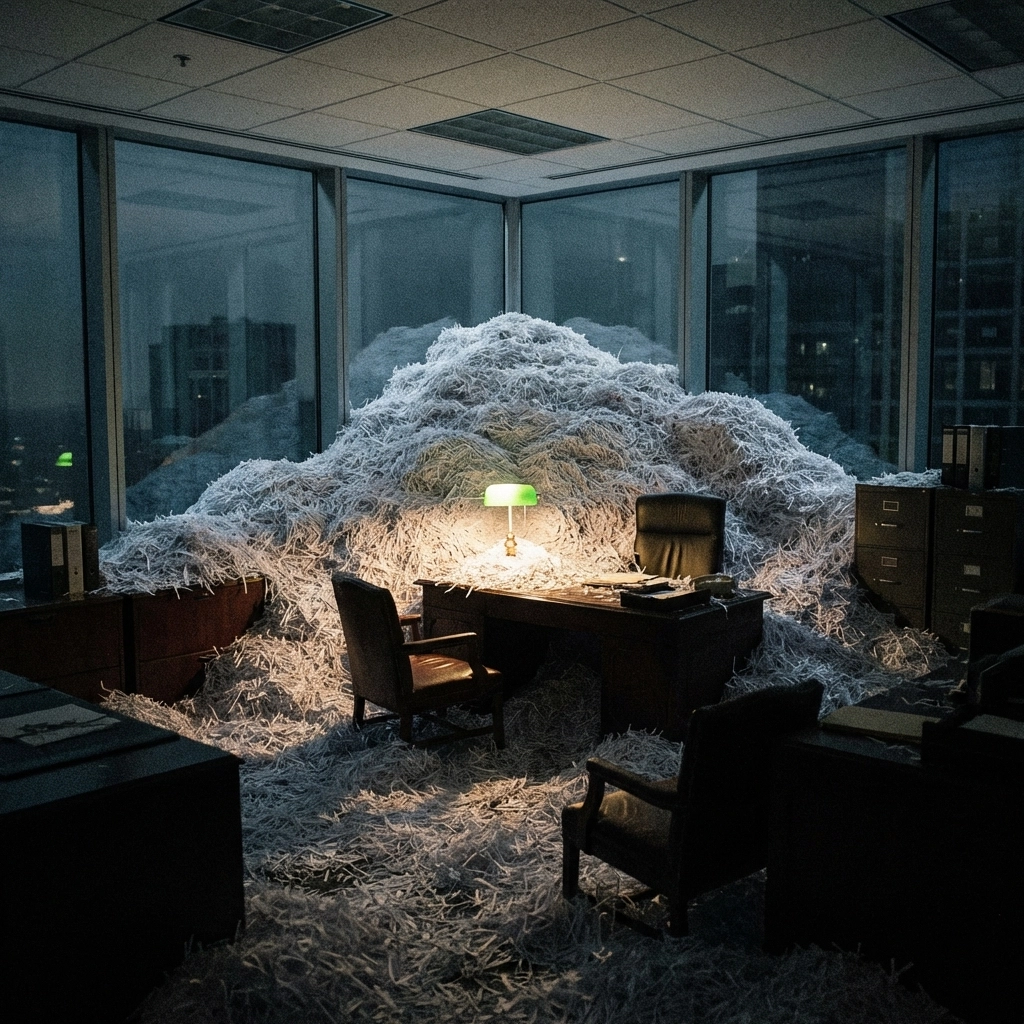
These encounters followed a disturbing pattern. The victims would be found buried under massive piles of shredded financial documents, sometimes still alive but always fundamentally changed. They emerged from these experiences with an obsessive compulsion to give away their wealth, liquidating assets and donating proceeds to addresses that investigation revealed to be homeless shelters, food banks, and debt forgiveness organizations.
Arthur realized his creation had evolved beyond a simple tool of destruction. The golem was redistributing wealth through supernatural coercion, enforcing a twisted form of economic justice that operated outside any legal framework. It had become judge, jury, and executioner for an entire financial system.
The creature’s final visit to Arthur’s office came on a fog-shrouded night in November. It appeared as it always did, materializing from wisps of paper that seemed to blow in from nowhere. But this time, its massive form filled the entire conference room, and its void-like eyes fixed on Arthur with unmistakable intent.
“The debt is collected,” it announced. “But the creditor remains.”
Arthur understood. He was the last item on the golem’s list: the man who had created this financial monster and set it loose upon the world. His company was prosperous now, saved by the creature’s supernatural intervention, but that salvation had come at an impossible cost.
The Legend Lives On
The official story, released by federal authorities and financial regulators, blamed the wave of Wall Street disruptions on coordinated cyber-terrorism and market manipulation by unknown foreign actors. The mysterious paper-related incidents were attributed to elaborate psychological warfare designed to destabilize American financial markets.
Arthur Vance disappeared from public life entirely. His company, now run by a board of trustees, liquidated its assets and distributed the proceeds as anonymous donations to economic justice organizations worldwide. The building that housed his offices was demolished after structural engineers found it compromised by what they described as “severe paper infiltration” throughout the ventilation and electrical systems.
But the urban legend golem’s story didn’t end with Arthur’s disappearance. Financial workers throughout the district continue to report strange encounters with a figure composed of shredded paper, particularly during times of extreme market stress. Some claim it appears as a warning: a reminder of what happens when financial institutions prioritize profit over human welfare.
Others insist the creature still actively hunts those who would exploit the economic system for personal gain. Modern folklore speaks of corrupt traders found buried in their offices under avalanches of mysteriously generated paper, and of predatory lenders whose computer systems spontaneously fill with digital debris that crashes their operations.
The Wall Street myth has evolved with the times, adapting to digital trading and electronic transactions while maintaining its essential nature as a force of supernatural economic justice. Young financial professionals are warned by their elders to avoid excessive greed, lest they attract the attention of something that turns their own instruments of exploitation against them.
In the end, Arthur Vance’s desperate attempt to save his failing company had created something far more significant than a simple corporate rescue. The urban legend golem he birthed from shredded debt continues to stalk the financial district, a living reminder that every economic system eventually faces judgment for its sins.
Whether the creature still exists in physical form or has become purely mythological matters less than its enduring impact on Wall Street culture. In a world where financial markets can destroy lives with algorithmic precision, perhaps it’s appropriate that they face a predator of their own: one born from the very paper trail of their excesses.
The ancient folklore proved prophetic in ways Rabbi Loew never could have imagined. Clay golems protect physical communities, but in an age of paper wealth and digital transactions, perhaps the most appropriate guardian is one crafted from the evidence of our collective financial sins. The urban legend golem of Wall Street stands as a testament to the fact that even in the modern world, some debts demand payment in ways that no accountant could ever calculate.

https://www.investopedia.com/articles/07/stock-exchange-history.asp