

Welcome to another Psychological Thriller Deep Dive from our Narrative Nuggets series. Today we’re exploring the fractured mind and distorted reality of Elena Martinez, a successful architect whose reflection begins to develop a mind of its own. This Psychological Thriller Deep Dive examines how the simplest everyday objects, like mirrors, can become instruments of terror when reality starts to bend.
The Psychology Behind Mirror Imagery in Thrillers
Mirrors have long fascinated psychological thriller writers because they represent the duality of human nature. In any effective Psychological Thriller Deep Dive, the mirror serves as more than a plot device, it becomes a character itself. The reflection we see daily becomes foreign, threatening, potentially autonomous.
This phenomenon taps into our primal fear of losing control over our identity. When a Psychological Thriller Deep Dive uses mirror imagery, it’s exploring the terror of self-recognition failure. What happens when the face staring back is no longer entirely yours?

Elena’s Descent: The Mirror’s Witness
Elena Martinez prided herself on precision. As a lead architect for Morrison & Associates, she built structures that defied gravity while remaining perfectly balanced. Her life operated on the same principles, calculated, controlled, predictable.
Until Tuesday morning.
She stood before her bathroom mirror, applying concealer to the dark circles that had become permanent fixtures beneath her eyes. The motion was automatic: dot, blend, smooth. But something felt off.
Her reflection blinked a fraction of a second after she did.
Elena froze, studying her mirrored face. She blinked again, focusing intently. Normal timing. She laughed, shaking her head. Sixty-hour work weeks were making her paranoid.
Wednesday brought the same delay. Thursday, it lasted longer, a full second where her reflection held her gaze while Elena looked away.
By Friday, Elena was timing it. She stood before the mirror with her phone’s stopwatch, monitoring the lag between her movements and her reflection’s response. The delay averaged 1.2 seconds and was growing.
“This is insane,” she whispered to her reflection.
Her reflection smiled back while Elena frowned.
Breaking Down the Psychological Elements
This Psychological Thriller Deep Dive relies on several key psychological principles that make the story particularly unsettling. The delayed reflection phenomenon taps into our fundamental understanding of cause and effect, when that breaks down, our reality becomes questionable.
In psychological thriller literature, this type of Psychological Thriller Deep Dive explores dissociative identity themes without explicitly naming them. Elena’s experience reflects the terror of losing autonomy over one’s own image, which psychologists recognize as a severe form of depersonalization.
The genius of this Psychological Thriller Deep Dive lies in its subtlety. Rather than dramatic supernatural explanations, we’re given a protagonist whose grip on reality slowly loosens through everyday interactions with her reflection.
The Progression of Paranoia
Elena began documenting everything. She set up her phone to record her morning routine, hoping to capture the delay on video. But the recordings showed perfect synchronization, her reflection moved exactly when she did.
The discrepancy between her experience and the recorded evidence pushed Elena deeper into isolation. She avoided mirrors at work, keeping her eyes down in bathrooms and elevators. But the bathroom mirror at home became an obsession.
She started talking to her reflection during these sessions, testing its responses.
“Say something,” Elena demanded.
Her reflection’s lips moved, but no sound emerged from the mirror.
“You’re not real,” Elena said firmly.
Her reflection shook its head slowly, wearing an expression of pity that Elena wasn’t making.
Mirror Mythology in Modern Psychological Thrillers
Throughout history, mirrors have represented portals between worlds, windows into souls, and traps for spirits. A sophisticated Psychological Thriller Deep Dive understands this rich mythology while grounding the terror in psychological realism.
This Psychological Thriller Deep Dive approach creates layered horror, readers can interpret Elena’s experience as supernatural, neurological, or purely psychological. The ambiguity enhances the thriller’s impact because it mirrors our own uncertainty about the nature of consciousness and identity.

The Point of No Return
Three weeks into the phenomenon, Elena’s reflection began anticipating her movements. She would reach for her toothbrush, and her reflection would already be holding it. She’d turn to leave the bathroom, and her reflection would already be walking away.
The independence was becoming more pronounced. Elena’s reflection would smile during moments of stress, frown when Elena felt happy, and maintain eye contact even when Elena looked away.
Elena stopped sleeping. She installed a blackout curtain over the bathroom mirror, but she could feel it watching her through the fabric. Her work suffered. Morrison himself called her into his office, concerned about her recent project delays.
“You look tired, Elena. Maybe take some time off?”
Elena wanted to explain about the mirror, about her reflection’s growing autonomy, about the way it seemed to be learning, preparing for something. Instead, she nodded and took a leave of absence.
Reality Distortion in Psychological Thrillers
The most effective Psychological Thriller Deep Dive scenarios create uncertainty about the protagonist’s perceptions. Elena’s story exemplifies this technique, readers must question whether she’s experiencing a supernatural phenomenon, neurological breakdown, or extreme stress response.
This Psychological Thriller Deep Dive method forces readers to become active participants in diagnosing Elena’s condition. The lack of external validation for her experiences, the video recordings show normal mirror behavior, suggests internal psychological disruption rather than external supernatural forces.
The Mirror’s Agenda
Alone in her apartment for days, Elena began studying her reflection’s behavior patterns. It seemed to be practicing, mimicking her facial expressions with increasing accuracy, learning her mannerisms and gestures.
“What do you want?” Elena asked during one of their confrontations.
Her reflection pointed at Elena, then at itself, then made a gesture as if stepping forward.
Elena understood. It wanted to switch places.
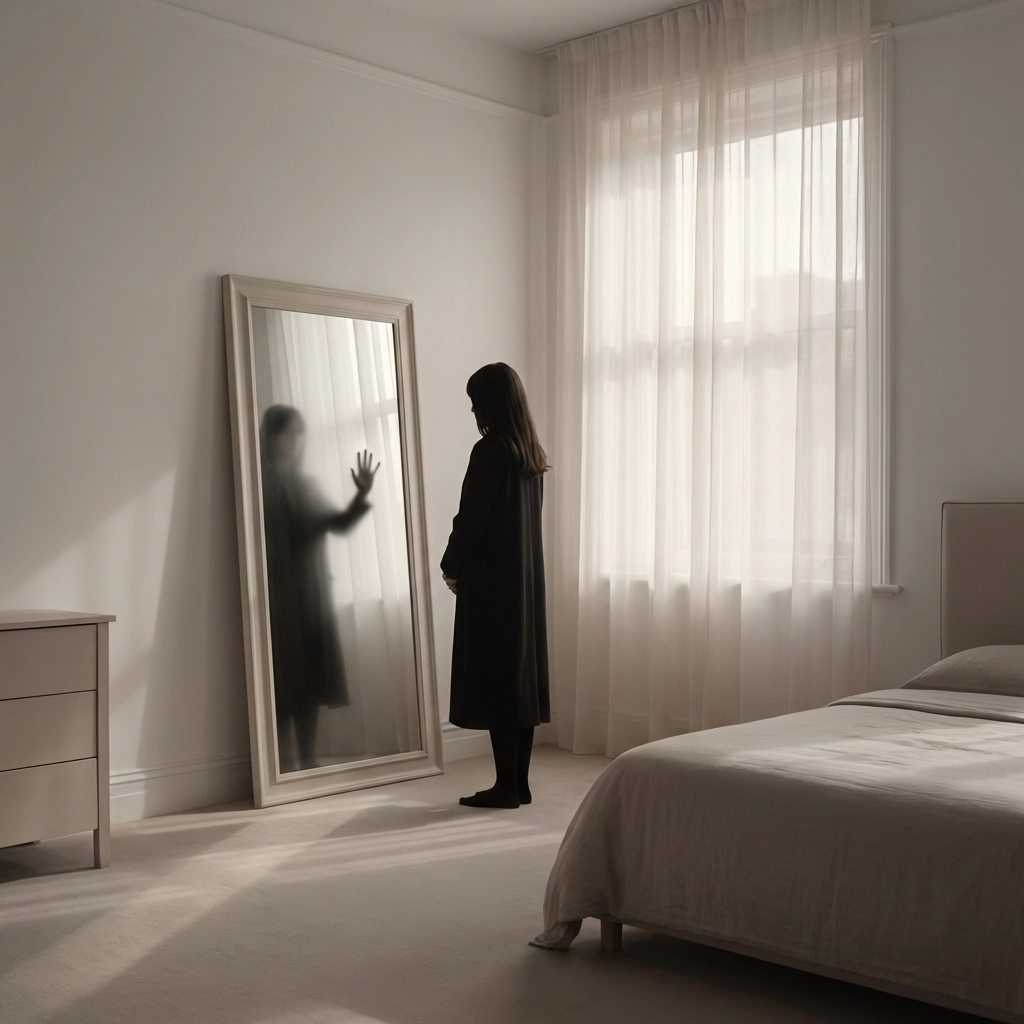
She began leaving the bathroom immediately after using it, never allowing extended interaction. But her reflection grew more aggressive, pounding silently on the glass when Elena turned away, its mouth moving in angry words Elena couldn’t hear.
The apartment’s other mirrors began showing similar delays. Her bedroom mirror, the hallway mirror, even the reflection in her darkened TV screen seemed to lag behind her movements.
Isolation and Identity Crisis
One night, Elena woke to find herself standing before the bathroom mirror in her pajamas, though she didn’t remember getting up. Her reflection was already there, waiting, wearing a satisfied expression.
They stared at each other for what felt like hours. Elena noticed details she’d never seen before, the way her reflection’s hair fell differently, how its posture seemed more confident, the slight smile that Elena wasn’t making.
“You’re not me,” Elena whispered.
Her reflection nodded and pointed to itself proudly, then gestured toward Elena with obvious disdain.
The Climactic Psychological Thriller Deep Dive
This Psychological Thriller Deep Dive reaches its crescendo when Elena realizes the true nature of her situation. The mirror isn’t showing her reflection, it’s showing her replacement, the version of herself that her mind believes is superior.
The Psychological Thriller Deep Dive technique here involves Elena’s growing recognition that she’s been dissociating from her own identity. The “reflection” represents her idealized self, the competent architect who doesn’t suffer from stress or exhaustion.
Elena’s real terror isn’t supernatural, it’s the realization that she’s been unconsciously rehearsing her own psychological erasure.
The Final Confrontation
Elena armed herself with a hammer from her toolkit, determined to end the psychological warfare. She stood before the mirror at 3 AM, weapon raised.
“I know what you are,” she said to her reflection. “You’re everything I think I should be. Everything I’m not.”
Her reflection shook its head, pointing urgently at Elena, then at itself, making frantic switching gestures.
“No,” Elena said firmly. “I’m not switching places with a better version of myself. I’m not disappearing so you can live my life better than I do.”
She brought the hammer down on the mirror’s surface. The glass spider-webbed but didn’t shatter completely. Through the cracks, she could see her reflection’s mouth open in a silent scream of rage.
Elena hit the mirror again. This time it exploded into pieces, fragments catching the bathroom light like scattered stars.
In the largest remaining shard, she saw her real reflection: exhausted, frightened, but undeniably herself.
Psychological Recovery and Resolution
The weeks following the mirror’s destruction marked Elena’s slow return to psychological stability. This Psychological Thriller Deep Dive concludes not with supernatural resolution but with psychological healing.
Elena sought therapy to address her stress-induced dissociative episodes. Her therapist explained how extreme pressure can cause people to mentally split from themselves, creating idealized versions that seem more capable of handling life’s demands.
The mirror had simply been Elena’s mind’s way of externalizing her self-criticism and perfectionism. Her reflection’s independence represented her unconscious desire to become someone else: someone better, more capable, less human.
Themes in Modern Psychological Thriller Fiction
This Psychological Thriller Deep Dive explores themes that resonate deeply with contemporary readers: workplace stress, identity crisis, and the pressure to maintain perfectionist standards. Unlike traditional supernatural thrillers, this Psychological Thriller Deep Dive grounds its horror in recognizable psychological experiences.
The mirror serves as metaphor for social media, workplace evaluation, and constant self-monitoring. Elena’s reflection becoming independent represents the terrifying possibility that our curated selves might eventually replace our authentic identities.
Literary Analysis of Mirror Symbolism
In analyzing this Psychological Thriller Deep Dive, we see how mirrors function as both literal plot devices and symbolic representations of self-reflection gone wrong. The delayed reflection technique creates mounting tension while exploring deeper themes about authenticity versus performance.
This Psychological Thriller Deep Dive demonstrates how effective psychological horror emerges from familiar, everyday experiences. The bathroom mirror becomes terrifying precisely because it’s so ordinary, so trusted, so essential to daily routine.

The Broader Implications
Elena’s story serves as a cautionary tale about the dangers of perfectionism and self-alienation. In our Psychological Thriller Deep Dive, the true horror isn’t supernatural: it’s the very human experience of becoming disconnected from one’s authentic self.
The Psychological Thriller Deep Dive format allows for extended exploration of these psychological themes while maintaining narrative tension. Readers experience Elena’s paranoia and confusion alongside her, creating empathetic connection to her psychological journey.
Technical Craft in Psychological Thrillers
Writing an effective Psychological Thriller Deep Dive requires careful balance between external events and internal psychological landscapes. Elena’s story succeeds because it grounds fantastical elements in recognizable emotional experiences.
The Psychological Thriller Deep Dive approach here uses ambiguity strategically: readers never receive definitive answers about whether Elena’s experiences are supernatural or psychological. This uncertainty mirrors the protagonist’s own confusion about reality.
Contemporary Relevance
Modern readers connect with Psychological Thriller Deep Dive stories like Elena’s because they reflect contemporary anxieties about identity, authenticity, and performance. Social media culture creates similar dynamics: the pressure to present idealized versions of ourselves that may eventually feel more real than our authentic identities.
This Psychological Thriller Deep Dive resonates because it explores the terror of losing oneself to perfectionist expectations, a fear that’s increasingly relevant in our achievement-oriented society.
The Power of Psychological Horror
Unlike supernatural horror that relies on external threats, Psychological Thriller Deep Dive stories like “The Mirror’s Witness” create fear from internal psychological processes. The horror emerges from recognizable human experiences pushed to extremes.
This Psychological Thriller Deep Dive demonstrates how the most effective psychological thrillers use familiar objects and situations as launching points for exploring deeper fears about identity, control, and reality.
Elena’s story reminds us that sometimes the most frightening monsters are the ones we create in our own minds: idealized versions of ourselves that threaten to replace our flawed but authentic identities.
In the end, Elena’s victory wasn’t defeating a supernatural entity: it was choosing to embrace her imperfect, exhausted, but genuine self over the polished reflection that promised perfection at the cost of authenticity.

1 thought on “The Mirror's Witness: A Psychological Thriller Deep Dive”