
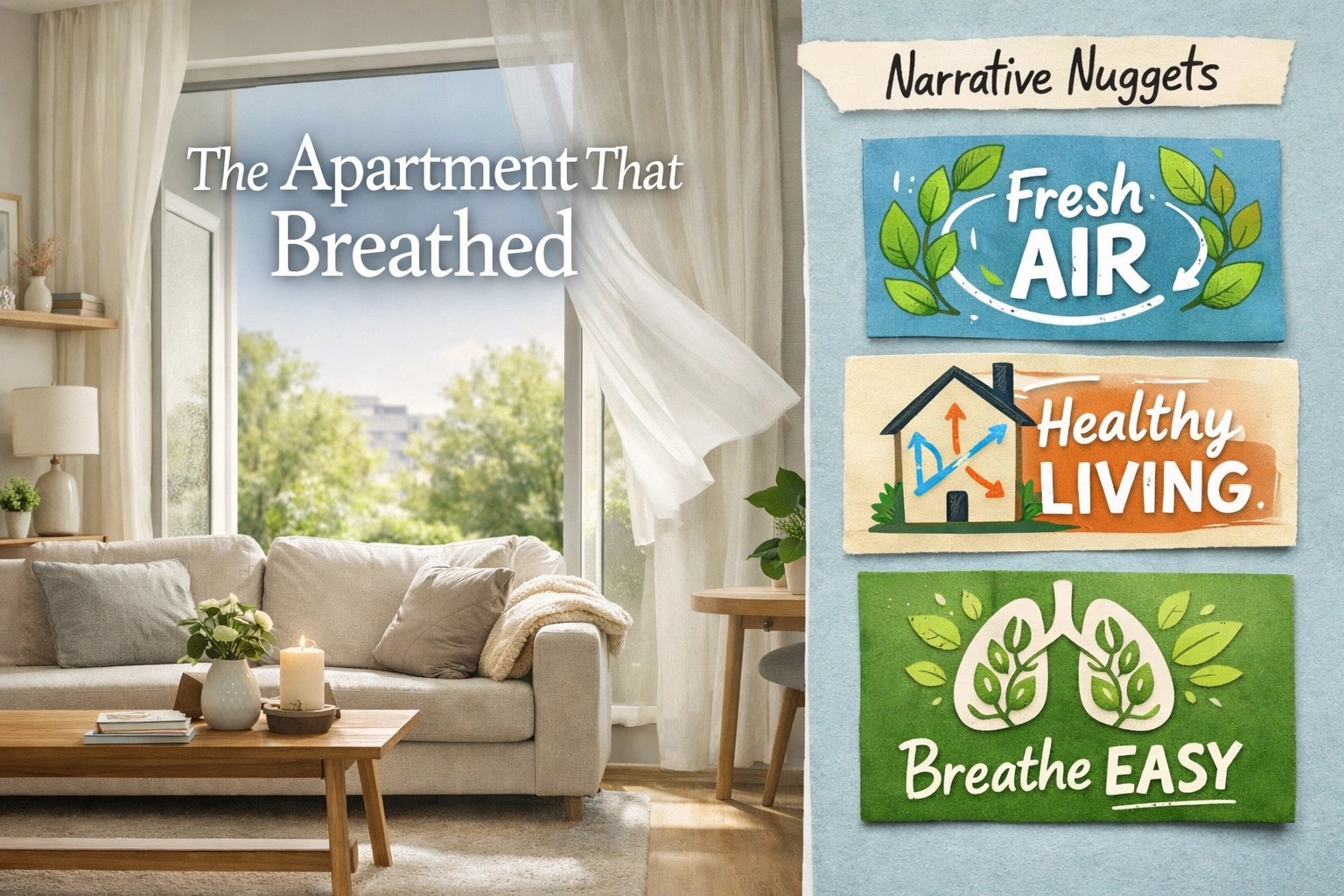
The lease was too good to be true. Lena knew it the moment she signed, but desperation has a way of making you ignore red flags. A one-bedroom in the heart of downtown for half the market rate? She told herself it was because the building was old, because the landlord was generous, because she deserved some luck after the year she’d had.
The first week, everything was fine. Normal, even. The apartment had character: exposed brick, high ceilings, those old radiators that clanged and hissed. It smelled faintly of lavender and old wood, like someone’s grandmother had lived there before. Lena unpacked her boxes, arranged her books, and tried not to think about the job she’d lost or the relationship that had imploded three months prior.
Then the walls started shifting.
When Body Horror Becomes Architecture
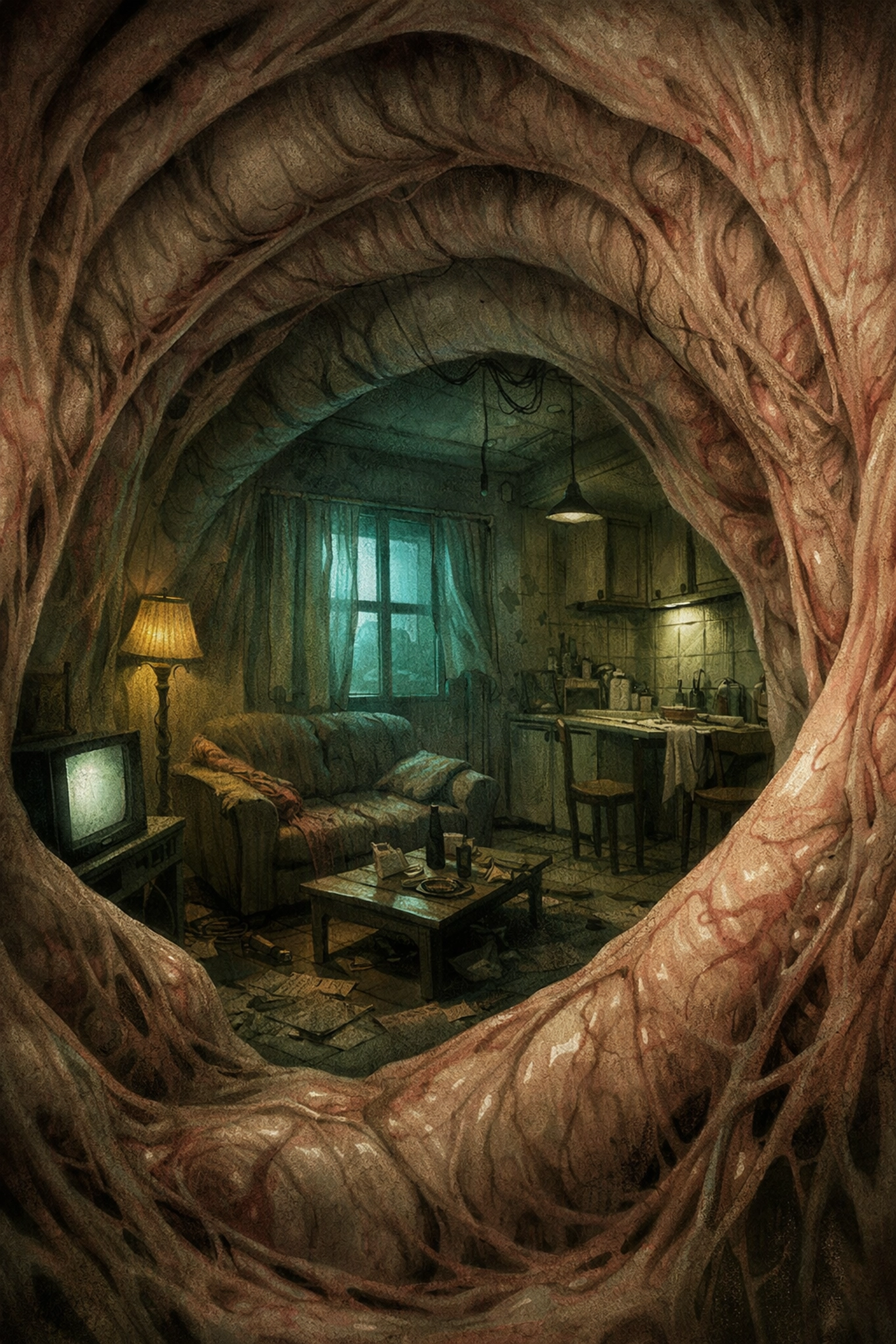
It began subtly. Lena noticed the bedroom closet door was slightly ajar one morning, even though she’d closed it the night before. The next day, the living room felt narrower: not dramatically, just enough to make her bump her hip on the coffee table she’d cleared by six inches the day before.
She measured. The room was three inches smaller on each side.
Body horror wasn’t something Lena thought about often, but she’d seen enough films to recognize the creeping dread of something organic invading a space meant to be static. This wasn’t a metaphor. The apartment was moving.
By the second week, the changes accelerated. The bathroom mirror hung lower each morning, forcing her to crouch to see her reflection. The kitchen cabinets tilted inward, their doors warping like arthritic fingers. When she touched the wall beside her bed, it was warm. Not radiator-warm. Skin-warm.
And it pulsed.
The Geometry of Anxiety
Lena called the landlord. He didn’t answer. She left three voicemails, each more frantic than the last. When he finally texted back, his message was terse: Old building. Settling. Normal.
But this wasn’t settling. This was adaptation.
The apartment seemed to sense her anxieties and physically manifest them. The ceiling in the bedroom began to lower incrementally each night, responding to her claustrophobia. The hallway stretched longer when she felt overwhelmed, forcing her to walk farther to reach the door. The kitchen shrank when she felt guilty about not cooking, the stove becoming harder to access, the refrigerator groaning every time she opened it.
Body horror, she realized, wasn’t just about viscera and transformation. It was about losing autonomy over your environment. It was about space becoming flesh, walls becoming organs, architecture becoming anatomy.
The Apartment Learns
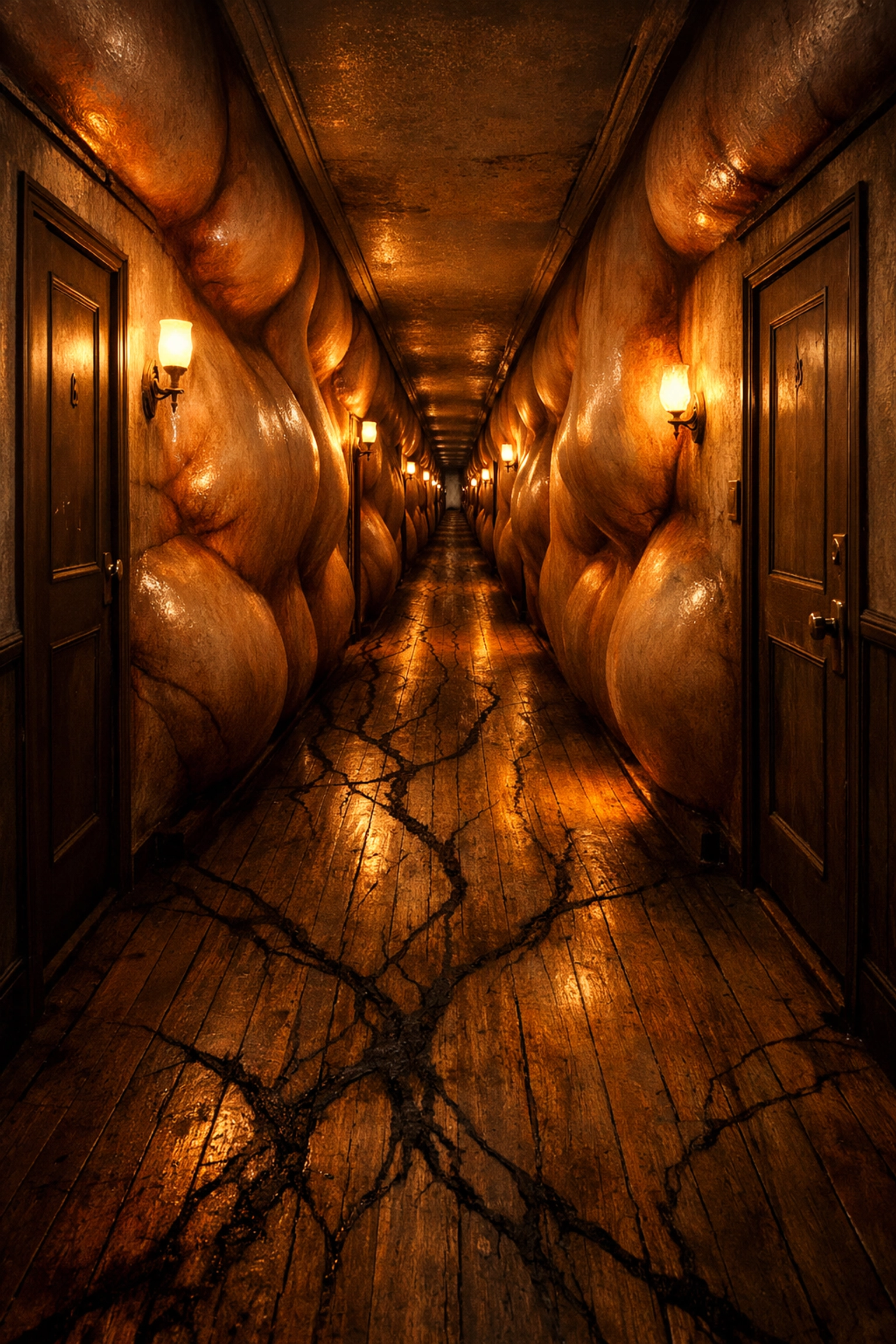
By the third week, Lena stopped sleeping. Every time she closed her eyes, she heard it: a slow, rhythmic sound like lungs filling and deflating. The walls breathed in sync with her own respiration, sometimes leading, sometimes following. When she held her breath, the apartment hesitated, then continued its own respiration independently.
It was learning.
The body horror deepened. The floorboards developed something like veins: thin, dark lines that branched and pulsed beneath the old wood. The exposed brick sweated a clear fluid that smelled faintly metallic. The bathroom sink drain began to close and open like a throat swallowing.
Lena tried to leave. She packed a bag and headed for the door, but the hallway had extended again: not by feet, but by what felt like miles. She walked for twenty minutes before giving up, turning back to find her apartment door exactly where she’d left it.
The apartment didn’t want her to go.
Reflection and Recursion
She started documenting everything. Photographs showed the changes clearly: walls bowing inward like a ribcage, the ceiling developing something resembling stretch marks, the corners of rooms becoming softer, more organic. The body horror was undeniable now, but no one believed her.
Her sister thought she was having a breakdown. Her ex suggested therapy. The landlord stopped responding entirely.
Lena began to notice something else. The apartment wasn’t just responding to her anxieties: it was mirroring them back to her, amplified. When she worried about being trapped, the doors became harder to open. When she felt judged, the walls seemed to lean in, observing. When she hated herself, the mirrors showed a reflection that looked increasingly wrong: not distorted, but disappointed.
The body horror wasn’t coming from the apartment. It was coming from her.
The Truth in the Walls
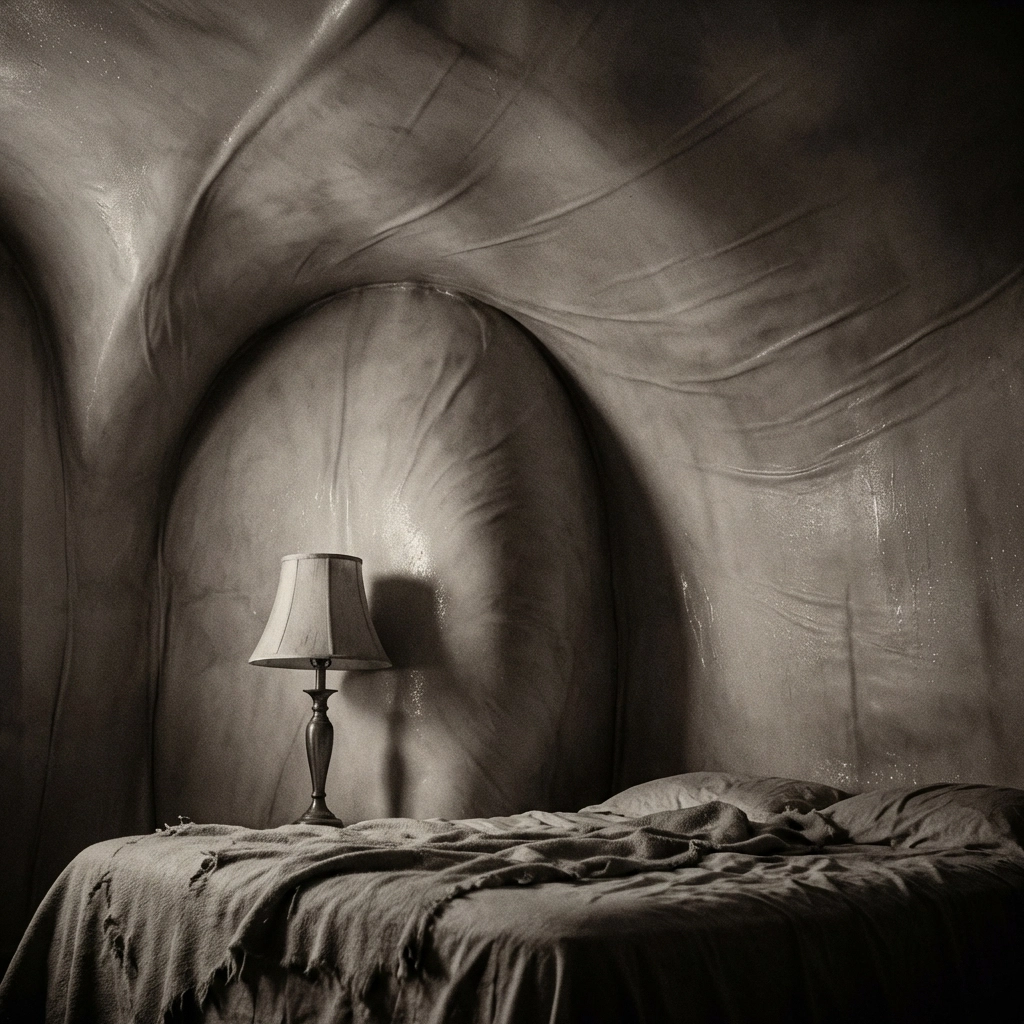
One night, three weeks into her tenancy, Lena woke to find the bedroom completely transformed. The walls had grown inward, forming a cocoon-like space barely larger than her bed. The surface was no longer drywall or brick: it was soft, warm, rhythmically expanding and contracting.
She was inside something alive.
And it was inside her.
The realization hit like a punch: the apartment wasn’t haunted. It wasn’t possessed. It was responsive. This was body horror in its purest form: not a monster attacking from outside, but a space that had become an extension of her own psychological state. Every anxiety, every fear, every moment of self-loathing had been absorbed by the walls and reflected back as physical transformation.
The apartment was breathing because she was suffocating.
Breaking the Architecture of Fear
Lena sat up in the narrow space, heart pounding. The walls pulsed faster, matching her panic. She forced herself to breathe slowly, deliberately. The walls hesitated, then followed her lead.
She spoke to the apartment. Out loud, in the dark, feeling insane but desperate.
“I see you,” she whispered. “I see what you’re doing. I see what I’m doing.”
The body horror that had consumed her environment began to feel less like an attack and more like a message. The apartment wasn’t trapping her: it was showing her what she’d been doing to herself. The narrowing spaces, the crushing ceiling, the lengthening hallways: all of it was a manifestation of how she’d been living since everything fell apart.
Small. Restricted. Afraid to move forward.
When Walls Become Mirrors
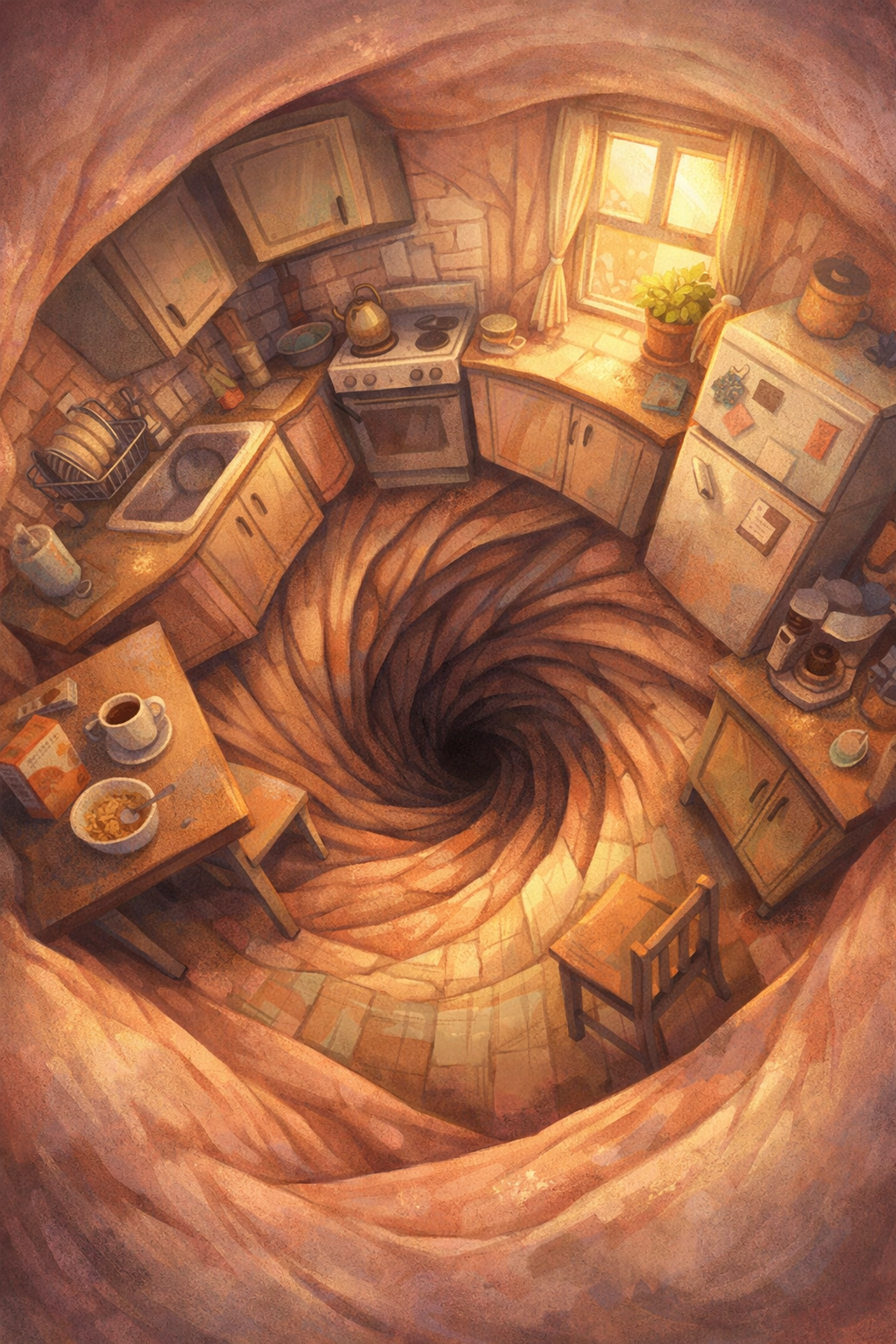
She started small. The next morning, Lena opened the windows she’d kept shut for three weeks. Fresh air flooded in, and the walls seemed to exhale. She cleaned the apartment, touching the surfaces without fear, acknowledging the strangeness without letting it paralyze her.
The body horror didn’t disappear overnight, but it began to recede. The hallway shortened by a few feet. The bedroom ceiling lifted an inch. The veins in the floorboards faded slightly.
She started cooking again. The kitchen expanded, just a little. She looked in the mirror and forced herself to smile, even when she didn’t feel it. Her reflection smiled back, no longer disappointed.
The apartment was still breathing, still warm, still alive in that unsettling way: but it felt less malicious now. Less like an attack and more like a companion. A strange, organic witness to her recovery.
Living with Body Horror
By the end of the first month, Lena understood what the apartment was. Not a curse, not a haunted space, but something more complex. It was a place that had absorbed so much human anxiety over the years that it had developed its own kind of sentience: a reactive consciousness built from the fears and hopes of everyone who’d ever lived there.
The body horror was real. The walls still pulsed. The floors still warmed to the touch. The architecture still shifted in response to emotion. But Lena had learned to work with it rather than against it.
She renewed her lease.
Some people might call that insane, choosing to stay in a space that literally embodies body horror. But Lena had learned something valuable in those walls: you can’t run from the things that scare you. They follow. They adapt. They find you in every space you occupy.
Better to face them in a place that’s honest about it.
The apartment breathed. She breathed with it. And slowly, incrementally, they both learned to relax.

Learn more about body horror in fiction at Tor.com
Keyword Focus: Body Horror
Tags: body horror, speculative fiction, short story, psychological horror, narrative nuggets, architectural horror, weird fiction, urban horror, body horror story, contemporary horror
SEO Description: An apartment molds itself to a tenant’s anxieties in this 1,500-word body horror story exploring architecture as psychology.