
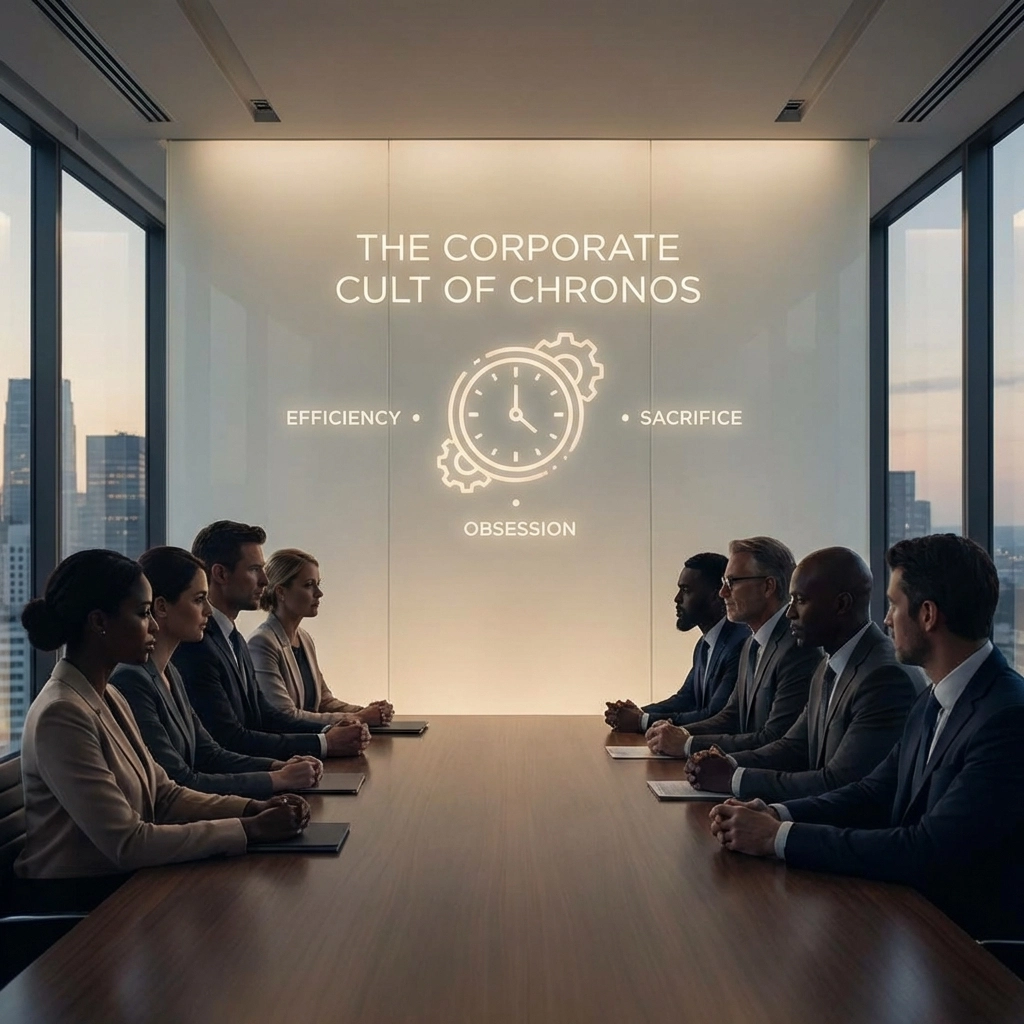
In an era where workplace culture has evolved into something barely recognizable from previous generations, this social satire story serves as both entertainment and cautionary tale. The modern obsession with productivity optimization, time management, and corporate advancement has reached fever pitch: making it ripe territory for satirical examination. What happens when the pursuit of efficiency crosses ethical boundaries? When does workplace dystopia become reality?
The Time-Lease Revolution: A Social Satire Story Unfolds
Arthur Pemberton adjusted his ergonomic lumbar support for the third time that morning, watching the digital display above his cubicle tick away the seconds. 3:47:12 remaining in today’s productivity window. The red numbers pulsed like a heartbeat, reminding every Chronos Corp employee that time wasn’t just money: it was literally life itself.

“Pemberton!” His supervisor’s voice cut through the ambient hum of keyboard clicks and motivational podcasts. “Conference room B. The Time-Lease coordinator wants to discuss your advancement opportunities.”
Arthur’s stomach clenched. He’d been working at Chronos Corp for eighteen months, steadily climbing from Junior Efficiency Specialist to his current role as Senior Productivity Optimizer. But advancement in this company came with a price that made traditional corporate ladder-climbing seem quaint.
The Time-Lease program was Chronos Corp’s revolutionary approach to employee development. Instead of waiting decades for retirement, employees could sell portions of their future leisure time in exchange for immediate “Efficiency Tokens”: corporate currency that purchased everything from better office assignments to actual salary increases. The more future time you sold, the faster you advanced.
It was brilliant. It was innovative. It was, Arthur was beginning to suspect, completely insane.
Corporate Greed Meets Time Management Humor
The conference room smelled like industrial-strength disinfectant and desperation. Janet Clockworth, the Time-Lease coordinator, sat across from Arthur with her trademark smile: the kind that never quite reached her eyes but had been perfected through seventeen corporate training seminars.
“Arthur, your productivity metrics are impressive,” she said, consulting her tablet. “You’re processing 23% more efficiency reports than your peers, and your time management humor during team meetings has boosted morale by 12%.”
“Thank you, Janet. I’ve been working on my: “
“Which is why we’re prepared to offer you something special.” Her smile widened impossibly. “The Premium Time-Lease package. Instead of selling individual hours, you can lease entire years of your retirement. Think about it: why wait until you’re sixty-five to enjoy success when you can have a corner office and executive parking today?”
Arthur stared at the contract she slid across the table. The numbers were staggering. Five years of his future retirement in exchange for immediate promotion to Vice President of Temporal Efficiency. The workplace dystopia was becoming more apparent by the day, but the allure of instant gratification was undeniable.
“What’s the catch?” he asked.
Janet’s laugh sounded like breaking glass. “No catch! You’re simply optimizing your life timeline. Our CEO, Mr. Chronos himself, has built this entire company on the principle that time is our most valuable resource. Why not leverage it like any other asset?”
The Social Satire Story Behind the Numbers
That evening, Arthur found himself researching Chronos Corp’s leadership team. What he discovered made his blood run cold. CEO Maximillian Chronos had founded the company in 1923. The same Maximillian Chronos who looked thirty-five in every company photograph dating back nearly a century.
The productivity culture satire was writing itself, but Arthur was beginning to realize he was living inside it rather than observing from the outside. He dove deeper into public records, employee testimonials, and corporate filings. The pattern that emerged was disturbing.

Every long-term employee who’d participated heavily in the Time-Lease program reported similar symptoms: premature aging, memory loss, and a peculiar inability to recall what they’d originally planned to do with their retirement years. Meanwhile, executive leadership appeared to grow more youthful and energetic with each passing quarter.
Arthur’s neighbor, Margaret, had worked for Chronos Corp for fifteen years. She’d traded nearly two decades of her retirement for advancement opportunities, reaching Senior Director of Temporal Resources by age thirty-five. Now, at forty-two, she looked sixty and couldn’t remember her grandchildren’s names.
“It’s probably just stress,” she’d told him last week, her hands shaking as she tried to pour coffee. “The demands of executive life, you know? But the compensation is incredible. I’ll retire wealthy.”
If she lived long enough to retire at all.
When Workplace Dystopia Becomes Reality
The next morning, Arthur arrived early to test a theory. Using his security clearance, he accessed the executive floor: something his recent productivity scores had granted him. The hallways were eerily quiet, decorated with portraits of company leadership spanning decades. The same faces, unchanged, staring down from gilded frames.
He found Maximillian Chronos’s office unlocked, the man himself absent but his presence lingering like expensive cologne and something else: something that smelled like time itself, if time had an odor. Old books, distant thunder, the moment before dawn breaks.
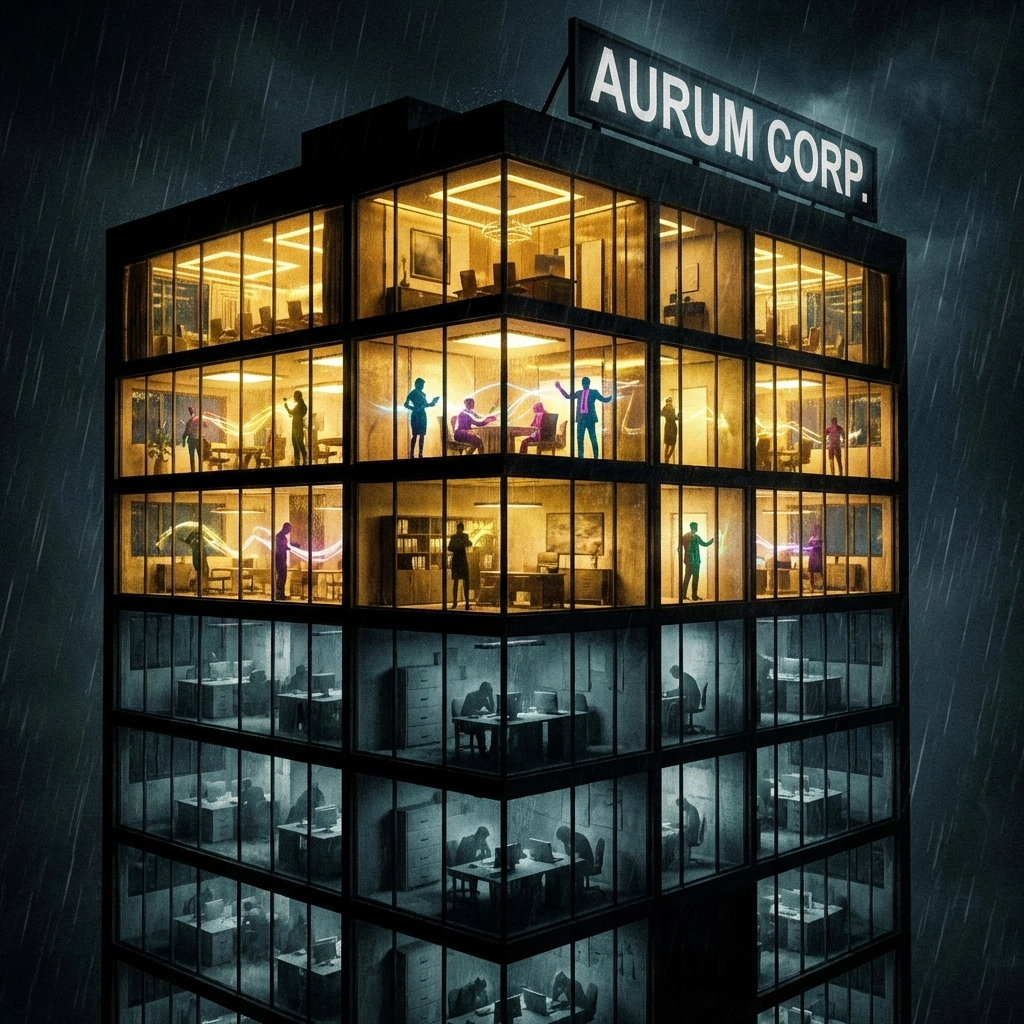
On the mahogany desk sat a peculiar device that looked like a cross between an antique clock and a medical apparatus. Tubes and wires connected to a series of glass vials, each labeled with employee ID numbers. Arthur recognized several: including Margaret’s. Her vial pulsed with a faint golden light, the liquid inside diminishing slowly but steadily.
“Fascinating technology, isn’t it?”
Arthur spun around to find Maximillian Chronos standing in the doorway. Up close, the man’s agelessness was even more unsettling. His skin had the waxy perfection of someone who’d never experienced a genuine moment of stress, despite running a Fortune 500 company for nearly a century.
“The Time-Lease program,” Chronos continued, closing the door behind him, “is humanity’s greatest innovation. We’re literally democratizing time itself. Instead of the wealthy simply purchasing luxury goods, we can now purchase life itself: minutes, hours, years of pure, unfiltered existence.”
“You’re stealing people’s lives.”
Chronos laughed, and Arthur noticed the sound carried harmonics that shouldn’t have been possible with human vocal cords. “Stealing? Arthur, my boy, we have contracts. Legal documents. Every employee signs willingly, eagerly even. They trade their twilight years for immediate gratification. It’s the ultimate expression of market capitalism.”
The Corporate Greed Behind the Time-Lease Social Satire Story
Arthur understood now why this situation felt like a social satire story: because the absurdity was real, just refined and legalized. The productivity culture satire had evolved beyond parody into actual corporate policy.
“How many employees’ time are you consuming?” Arthur asked, trying to keep his voice steady.
“All of them, eventually.” Chronos gestured to the device on his desk. “The beauty of the Time-Lease program is its scalability. Entry-level employees sell hours, middle management sells days, executives sell years. And I… I purchase immortality one contract at a time.”
The machine hummed softly, and Arthur could see dozens of vials, each representing a colleague whose future was being slowly drained away. The workplace dystopia wasn’t coming: it was already here, dressed up in productivity seminars and efficiency metrics.

“You can’t be serious about this. People have families, dreams, plans for their retirement: “
“Had,” Chronos corrected. “They had those things before they signed their contracts. Now they have corner offices and executive parking spaces. Fair trade, wouldn’t you say?”
Arthur realized he was looking at corporate greed in its purest form: not just the theft of money or resources, but the literal theft of human time. And worse, it was completely legal.
Breaking the Clock: Time Management Humor Turns Dark
Arthur spent the following weeks carefully documenting everything. The Time-Lease contracts contained loopholes that would make a carnival barker blush. Employees weren’t just selling future retirement time: they were selling their actual lifespan, compressed and redistributed to corporate leadership.
The productivity culture satire had become horror, but Arthur discovered something else: the system had a weakness. The temporal energy extraction required willing participation. The moment an employee truly understood what they’d signed away and genuinely withdrew consent, the connection severed.
But there was a catch. Withdrawal of consent required accessing memories that the time-drain process systematically erased. Most employees couldn’t remember what they’d originally planned to do with their stolen years.
Arthur began subtly reminding colleagues about their forgotten dreams. Margaret’s vial stopped glowing the day she remembered her plans to open a pottery studio. James from accounting broke free when Arthur helped him recall his dream of writing a novel. One by one, Arthur was sabotaging the system from within.

But Chronos noticed. The CEO’s appearance began to show subtle signs of aging as his supply of stolen time dwindled. During their next encounter, his voice carried a sharp edge.
“You’re costing me years of life, Arthur. Decades, possibly. Do you understand the economic impact of your interference?”
“I understand that you’re a parasite,” Arthur replied. “And parasites don’t get to complain when the host develops immunity.”
The Ultimate Social Satire Story Resolution
The final confrontation took place in the server room where Chronos kept his temporal extraction mainframe: a massive device that looked like something from a steampunk fever dream crossed with modern supercomputing technology. Arthur had spent weeks learning the system, understanding how to disrupt the time-flow without killing the employees whose essence was trapped inside.
Chronos appeared as Arthur began the shutdown sequence, but the CEO looked different: older, more fragile, his immortal facade cracking like old paint.
“You can’t destroy a century of work!” Chronos lunged for the controls, but Arthur had anticipated this.
“Watch me.” Arthur activated the reversal protocol, a hidden subroutine he’d discovered in the system’s original programming: apparently, even Chronos had built in safeguards, possibly from a forgotten moment of conscience decades ago.
The machine screamed: actually screamed: as temporal energy began flowing backward. Throughout the building, Arthur could hear employees gasping as their stolen years flooded back into them. Margaret would remember her pottery dreams. James would recall his novel. Hundreds of workers would suddenly understand what they’d lost and, more importantly, what they could still reclaim.
Chronos aged rapidly, his carefully maintained appearance collapsing like a time-lapse video in reverse. But he didn’t die: he simply became what he should have been all along: a very old man who’d lived far beyond his natural span.
“The contracts: ” Chronos wheezed.
“Are void,” Arthur finished. “Turns out fraud cancels all agreements, even ones written in legalese and temporal energy.”
Epilogue: When Time Management Humor Becomes Wisdom
Six months later, Arthur submitted his resignation letter to the interim management team. Chronos Corp had restructured completely, becoming a more traditional consulting firm focused on legitimate productivity improvement rather than literal life extraction. The Time-Lease program was discontinued, its equipment donated to temporal research scientists who were still trying to understand how it had worked in the first place.
This social satire story serves as a reminder that in our rush to optimize every aspect of human existence, we must be careful not to optimize away our humanity itself. The line between workplace improvement and workplace dystopia is thinner than most people realize, and corporate greed will always find new ways to package exploitation as innovation.
Arthur kept Chronos Corp on his resume but listed his job title as “Temporal Liberation Specialist.” When recruiters asked what that meant, he’d smile and suggest they be very careful about any company that asked them to sign their time away.
After all, time management humor only works when you still own your time to manage.
