
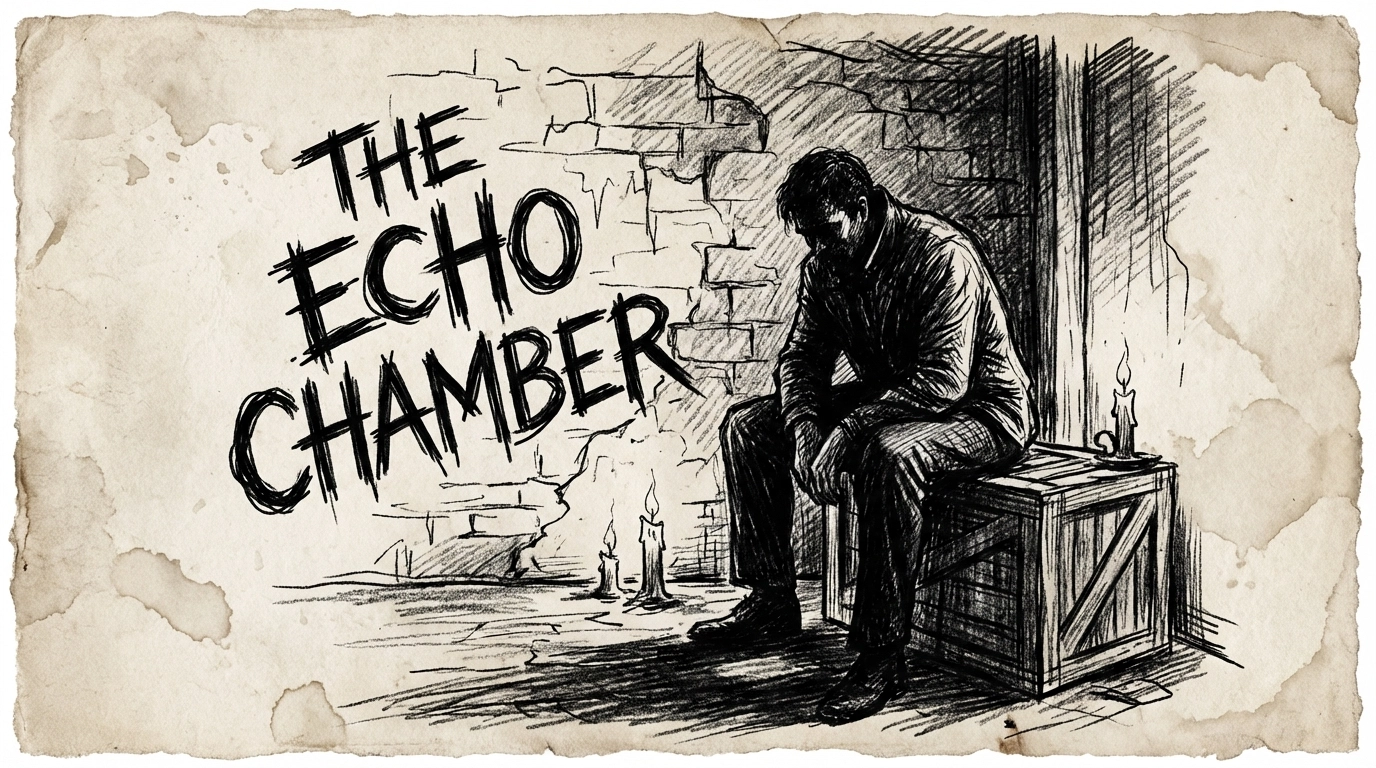
Dive into this Psychological Thriller Story where memories are currency and the truth is the ultimate trap.
Reading time: 12–14 minutes
Part One: Psychological Thriller Story — The Room That Remembers
The fluorescent lights hum a frequency that crawls under my skin. I wake up to white walls. White ceiling. White sheets that smell like bleach and something older. Something organic. Something that doesn’t belong in a clean place.
This is a Psychological Thriller Story, I think. That’s the first complete thought I can hold.
My name is Elias. I’m pretty sure.
I sit up. My skull feels packed with cotton. Missing hours. Missing days. Maybe missing years. The room is simple: a bed, a chair bolted down, and a door with no handle on my side. On the far wall, a mirror. When I look, a stranger stares back with my eyes.
Same face. Less person.
“Good morning, Elias.”
The voice comes from the ceiling, maybe the walls. No speaker grill. No camera I can see. The room acts like it’s never been touched by human hands.
“Where am I?” My throat is dry, like I swallowed dust.
“You’re safe. You’re inside The Echo Chamber.”
The phrase lands heavy. It’s a place name and a warning.
“I don’t remember coming here.”
“That’s normal. We’re protecting you from harm.”
I try to stand. My legs wobble. I reach for the chair but it’s farther than it should be, like the room stretches when I’m not looking. Twisted reality. Small, petty distortions. The kind that says, you don’t make the rules anymore.
I stare at the mirror again. The reflection doesn’t lag, but it feels wrong. Like it’s watching me back.
This Psychological Thriller Story starts the way these things always start: someone wakes up, and the world acts like it already knows them.
Two words burn behind my eyes as if they’ve been carved there: memory harvest.
I don’t know what they mean. I just know they’re mine.
Short taglines follow each section now. The first one comes easy.
Hold steady.
Part Two: Psychological Thriller Story — The Doctor Who Sells Suspense Fiction
The door opens without sound. A woman steps in like she’s always had access to my life.
Dr. Elise Vance. Her badge says it. Her posture says it more. Tall. Precise. Silver hair cut close. Eyes like fog that never lifts.
She sits across from me with a tablet and a smile that’s technically a smile.
“Elias. How are we feeling today?”
“Like I’m missing pieces.” I hear my own voice and it feels rented. “How long have I been here?”
“Three weeks.”
I wait for something to click. It doesn’t.
“I don’t remember three weeks.”
“That’s expected.” She taps her screen. “You experienced a psychological break. Fragmentation. Dissociation. We brought you here to stabilize.”
“I came here?”
“Voluntarily.” She turns the tablet toward me.
A form. A signature. My handwriting. My name: Elias Reed. Date stamped like a verdict.
I stare at it like it might turn into a joke if I stare long enough.
“I don’t remember signing.”
“You wouldn’t.” She’s calm. Almost bored. “We run selective suppression. We remove compromised pathways so the mind can rebuild.”
My stomach dips. It’s the tone. Not what she’s saying. The way she says it like she’s describing a cleaning routine.
“And if I don’t want that?”
She gives a small shrug. “Most people think they don’t. Then the pain returns. Then they beg us to continue.”
This is where the story in my head tries to label itself again. Psychological Thriller Story. Suspense fiction. Mind games. It wants a category so it can predict the next beat.
Dr. Vance stands. Smooths her white coat.
“Trust the process, Elias. Your paranoia isn’t evidence. It’s your brain improvising. An Unreliable narrator can make anything feel true.”
The phrase Unreliable narrator hits me like a shove. Not because it’s clever. Because it’s accurate.
She leaves. The door seals. No click. No latch. Just done.
I turn to the mirror. The stranger is still there.
So am I. Probably.
Stay sharp.
Part Three: Psychological Thriller Story — Mind Games in The Echo Chamber
Days pass in measured doses. Food slides through a slot. Same texture. Same taste. Like nutrition has been stripped down to numbers.
Twice a day, orderlies escort me down a corridor that looks copied and pasted. They never speak. Their faces blur at the edges when I try to study them. Not literally. More like my brain refuses to keep them.
Dr. Vance runs sessions in a dim room with a single table.
She shows me photos.
A house I’m supposed to recognize. A dog I’m supposed to love. A woman I’m supposed to miss. A little boy with my eyes and someone else’s grin. A family posed like an advertisement for happiness.
“What do you feel?” she asks.
“Nothing.” It’s honest. It’s also terrifying.
She nods like that’s progress.
“The mind games your condition plays are sophisticated,” she says. “Your mind is defending itself by rewriting context.”
“From what?”
She pauses. Just long enough to feel intentional.
“Your family,” she says. “The loss.”
The word family makes my chest tighten. I get a flash: tiny sneakers left by a door. A laugh. A smell—orange shampoo, maybe. Then static. Then blank.
“I don’t remember a family.”
“Exactly.” She leans in. “That’s the fracture. The Dark mystery is not what happened. It’s what your mind refused to carry.”
Dark mystery. Another label. Another hook. She’s feeding me keywords like pills.
I look at the photo of the woman again. Dark hair. Half smile. Her eyes feel like a door I can’t open.
“What’s her name?” I ask.
Dr. Vance watches me like I’m a lab result. “Mara.”
Mara. The syllables scrape something raw.
I want to say I remember. I don’t. But I do remember the feeling of trying to remember. Like digging with bare hands in frozen dirt.
Suspense fiction thrives on gaps. So does trauma.
If this place is treatment, why does it feel like surveillance?
If it’s care, why does it feel like conditioning?
In the hall back to my cell, I catch my own reflection in a panel of glass. For a second, it looks like I’m smiling. I’m not.
Twisted reality doesn’t always bend the world. Sometimes it bends you.
Keep moving.
Part Four: Psychological Thriller Story — Becoming My Own Unreliable Narrator
It starts with inconsistencies.
A date on a tray doesn’t match the date Dr. Vance says out loud. My meals change portion sizes like someone is testing variables. The hallway lights flicker in a pattern I can’t unsee. Three short. Two long. Like code.
The mirror gets worse.
Sometimes my reflection turns its head a beat late. Sometimes it looks tired when I don’t. Sometimes, behind me, there’s a shape that isn’t there when I spin around.
I begin to count. Steps from bed to door. Seconds between light hum changes. The number of times I blink in a minute. I’m building a case in my head because it’s the only structure I have.
This is a Psychological Thriller Story and the only weapon I own is attention.
One afternoon, Dr. Vance steps out to take a call. She leaves the tablet on the table. She doesn’t lock it. That feels either careless or staged.
I move anyway.
A folder labeled: SUBJECT 23 — ECHO.
My file.
STATUS: CONDITIONING PHASE III
NOTES: Subject responding well to implanted memories. Integration of “family” narrative proceeding as planned. Recommend increased emotional reinforcement.
ADD: Subject displays persistent meta-awareness. Reinforce story-frame: “Psychological Thriller Story.”
My mouth goes dry.
Implanted memories.
Story-frame.
They’re not healing me. They’re writing me.
Dr. Vance returns. I’m back in my seat. Hands folded like I’m polite.
“Where were we?” she asks.
“You were telling me about Mara,” I say.
Her eyes narrow—just a millimeter. But it’s enough.
“So you do remember,” she says, and her tone is satisfied. Like she just watched a graph rise.
In that moment, I get it: the Unreliable narrator isn’t only me.
It’s the room. The doctor. The whole facility.
And the scariest part is how easily my brain wants to comply. It wants a plot. It wants closure. It will accept almost anything if it means the static stops.
Mind games don’t need force. They need fatigue.
Don’t blink.
Part Five: Psychological Thriller Story — The Architecture of Twisted Reality
I stop sleeping. Not out of bravery. Out of survival.
When I sleep, I dream in scripts. Voices reading lines. Mara’s face repeating like a looping clip. A child crying in another room. Every dream ends with a soft beep and the smell of antiseptic. Like someone is resetting me.
So I study the cell.
Every Psychological Thriller Story has a prison. Every prison has a flaw.
I find mine behind the bed: a seam where two wall panels meet wrong. I scrape at it with the edge of my tray until my fingertips ache. Hours. Maybe days. Time is slippery here.
Finally, the panel gives.
Behind it: wiring. A small maintenance cavity. A vent shaft big enough for a thin man with no other options.
I climb in.
The metal is cold. Dust tastes like pennies. I crawl through darkness, guided by the dull thrum of machines.
Then I drop into a room that is not meant to exist.
Servers. Racks. Monitors. A wall of live feeds: people in identical cells, staring at identical mirrors, being quietly rewritten.
On one screen, a slide deck:
PROJECT: THE ECHO CHAMBER
Objective: Psychological restructuring via controlled narrative implantation.
Method: Memory harvesting, suppression, and reintegration.
Applications: consumer compliance, witness shaping, identity replacement.
Memory harvesting.
So that phrase in my head wasn’t metaphor. It was a receipt.
On a desk, an unattended tablet shows trending tags, like they’re optimizing a campaign:
- memory manipulation
- unreliable narrator twist
- liminal space horror
- gaslighting suspense
- secret facility thriller
- grief-driven protagonist
They’re treating people like content. A/B testing lives.
I record what I can. Photos of screens. A quick video sweep. My hands shake but I keep going. This is evidence. This is leverage. This is my exit.
Behind the monitors, I spot something else: a wall map of the facility. My cell labeled E-23.
Under it: another label I don’t like.
REPEAT CYCLE: 11.
Repeat cycle.
How many times have I crawled out and been put back?
How many times have I “escaped” inside a script?
Suddenly, I don’t trust my own fear. I don’t trust my adrenaline. I don’t trust the satisfaction of “finding the truth” because that could be part of the truth they want me to find.
Psychological Thriller Story. Suspense fiction. Dark mystery. The room is full of genre and none of it feels like entertainment.
I hear footsteps outside.
I climb back into the vent.
No comfort.
Part Six: Psychological Thriller Story — Suspense Fiction Turns Physical
Alarms start like a migraine. Lights shift to red. The facility’s calm mask drops.
They found my empty cell.
I run down corridors that look identical, like someone designed the place to erase direction. The hum in the lights rises. It feels like pressure behind the eyes.
“Elias,” Dr. Vance’s voice echoes through hidden speakers. “Stop. You’re destabilizing. What you think you found is a delusion. Your brain is constructing a Psychological Thriller Story to avoid—”
“Avoid what?” I shout back. “Avoid you stealing my memories?”
“Harvesting,” she corrects, too quick. Then she catches herself. A tiny slip. A human mistake.
I slam into an intersection. Two corridors. Same. Same. My heart thuds like it wants out.
Dr. Vance steps into view ahead. Hands raised. Calm face. Perfect posture. She looks like the kind of person who believes she’s saving the world with paperwork.
“Elias,” she says, “you volunteered. You asked for this. The grief was turning you into someone dangerous—to yourself. We offered you relief.”
“Relief?” My voice shakes. “By turning my life into mind games?”
“You call it mind games because you need an antagonist,” she says. “But you came to us for a new story.”
She takes a step closer.
“Your wife,” she says. “Your son.”
The words land and something inside me splits.
A flash: car headlights on wet asphalt. A child seat. A small hand reaching. Mara’s voice yelling my name—Elias—then a crunch like the universe breaking a tooth.
My knees threaten to fold.
“Christmas Eve,” Dr. Vance continues softly. “You were driving. A truck crossed the line. You survived. They didn’t. After that, you begged for forgetting.”
My mouth opens. Nothing comes out.
“Come back,” she says. “Let us finish. Let us close the wound.”
This is where the twist should feel satisfying. It doesn’t. It feels like drowning.
Because I can’t tell if those flashes are real memories returning… or implanted memories finally sticking.
Unreliable narrator. That’s me. That’s the facility. That’s the entire world right now.
I clutch the tablet against my chest like a talisman. Evidence is only evidence if reality is stable enough to hold it.
I back toward an EXIT door marked with a green sign.
Dr. Vance’s eyes flick toward it. A tell. A real reaction.
Good.
I shove the door and run.
No going back.
Part Seven: Psychological Thriller Story — The Echo That Follows
Outside is night. Actual night. Cold air. Pine smell. A sky full of indifferent stars.
I run until my lungs burn and my legs turn to jelly. I don’t hear pursuit. That makes it worse.
I find a road. A truck stops. The driver doesn’t ask many questions because he doesn’t want many answers. He drops me at a motel that looks like it’s been waiting for people to hide in it.
Inside the room, the lamp flickers like it’s struggling to stay alive.
I lock the door. Then I lock it again. Then I sit on the bed with the tablet in my hands.
The files are there. The slide deck is there. The patient feeds. The repeat cycle note.
Irrefutable.
But then I find a video file labeled:
Elias_Reed_Consent_Final.mp4
Dated two months before my admission.
I press play.
My own face fills the screen. Gaunt. Red-eyed. Like someone who hasn’t slept in a year. I’m holding a photo of Mara. The same woman from the sessions. Only here she looks more alive. Less curated.
“My name is Elias Reed,” the recording says. My voice—raw and shaking—sounds like it’s scraping itself apart. “I am consenting to the Echo Chamber Protocol. I want to forget. I want to forget them. I can’t carry it anymore. Please give me a new life. Give me a new Psychological Thriller Story, one where they don’t die, one where I don’t have to remember the sound.”
The video ends.
I stare at the blank screen.
So Dr. Vance wasn’t fully lying.
But she wasn’t telling the full truth either.
Because consent given in a collapse isn’t clean. It’s a bargain made with a burning house.
I look at the mirror on the motel wall. My reflection looks normal. Too normal.
Then, for half a second, I see a small figure behind me. A boy. About five. He’s holding a toy car. He looks at me like I abandoned him.
I spin around.
Empty room.
Twisted reality doesn’t stop because you change locations. It travels inside the skull.
I sit back down.
This is the part where a Psychological Thriller Story usually offers a choice: return to the experiment and surrender, or keep the pain and keep the self.
But I don’t know which option is real. And I don’t know if the choice is mine.
I open the photo of Mara again. Her eyes feel like a lock I once had the key to.
I whisper her name anyway.
“Mara.”
And something in me answers—not a voice, not a hallucination—just a heavy, undeniable feeling.
She existed.
My son existed.
And that means the grief exists too. It’s not a symptom. It’s proof.
I don’t get a happy ending. I get a direction.
I stand, grab the tablet, and leave the room.
I don’t know where I’m going. I just know I’m not letting anyone edit me again.
Psychological Thriller Story after Psychological Thriller Story plays in my head like a strobe light: escape, denial, reveal, chase, twist, choice—repeat.
But this time I’m writing the next line with my feet.
Lasting value.
Epilogue: Psychological Thriller Story — The Chamber Opens
Six months later, a man matching my description works at a coastal bookshop three thousand miles from the facility. He keeps his head down. He smiles at customers. He never talks about his past.
They say he’s quiet. Polite. A little haunted.
Sometimes, late at night, someone hears him in the back aisle, whispering two names like a ritual. Like a promise.
Mara.
Theo.
He keeps a cheap flip phone and a worn photo tucked into his wallet. He doesn’t show it to anyone because he’s afraid the picture will change if another set of eyes touches it.
He reads books about memory. About trauma. About how the brain can lie while trying to protect itself. He reads about false memories. About suggestibility. About retrieval cues. About how grief can turn time into a looping hallway.
He learns that the mind is not a vault. It’s a storyteller.
And that makes every life a Psychological Thriller Story if you push hard enough.
Some minds can’t be rewritten cleanly. Some people keep the wound because the wound has names inside it.
The Echo Chamber wanted compliance.
He chooses remembering.
He chooses the Dark mystery over the easy lie.
He chooses to live with being an Unreliable narrator—so long as the narration is his.
He locks up the shop at night and walks home by the water, listening to the waves repeat the same line over and over.
Echoes.
Always echoes.
Keep building.

Learn how memory can be distorted and reshaped (APA Dictionary of Psychology: “false memory”)